
The last metre
Your customer strategy plays out in a conversation of under a minute: what shoppers expect, and what a failed exchange costs.
White paper · Retail
Offering the loyalty card, approaching a hesitant customer, turning a complaint around: the conversations that drive sales in store and in customer service are not learnt. They are practised.
12 pages, with a source for every figure. For sales, marketing, customer service and learning leaders in retail.
Customer case · Supermarchés MATCH
Results measured among learners on the Supermarchés MATCH programme, detailed in the white paper.
Inside
Your customer strategy plays out in a conversation of under a minute: what shoppers expect, and what a failed exchange costs.
Three to sell, three to repair: the scene, what goes wrong, the stakes and the criterion to observe.
We overestimate the “no” by almost half, difficult customers are the norm, and teams keep changing.
Self-efficacy, behaviour modelling and simulation: what research says about confidence and transfer.
Create, practise, debrief: how AI simulation connects marketing, sales and service.
MATCH, Cdiscount, Eurotunnel / LeShuttle and Bluelink, then a week-by-week plan and six questions to take stock.
Excerpt · The six moments
Twenty seconds, a queue, and a question that often never gets asked.
An open question about their plans before any argument.
Linked to the need they have expressed, and a “no” accepted gracefully.
Out of stock or late delivery: a concrete solution before they leave.
Let them finish, restate the problem, say what happens and when.
No question asked twice, and a dated commitment you can keep.
One moment, one in-store indicator, fifteen to twenty real verbatims and objections.
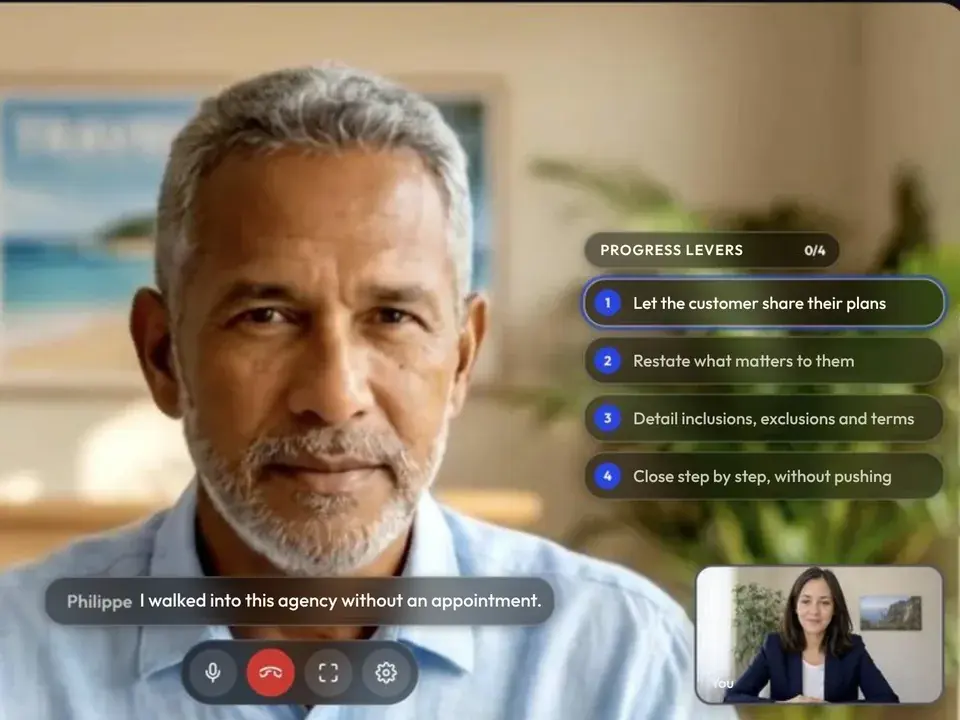
Two or three AI customers, then five minutes of practice per person per week.
Practice volume, score progression, first signals in store. Then a second moment.
The method
“The mystery shopper reveal turned the room around. Suddenly, everyone wanted to practise.”Retail training manager, Supermarchés MATCH
“For the first time, our agents go out on the ground having already lived the conversation.”Denis Lavoisier, Head of Trainers, Eurotunnel
The white paper shows you where to start, in thirty days.