
What the classroom does best
And what it cannot do: the constraint is logistical, not educational.
Practical guide · 2026
The trainer's guide: convert your role-plays, write your personas, debrief, assess. Methods, templates and pitfalls, with no sales pitch.
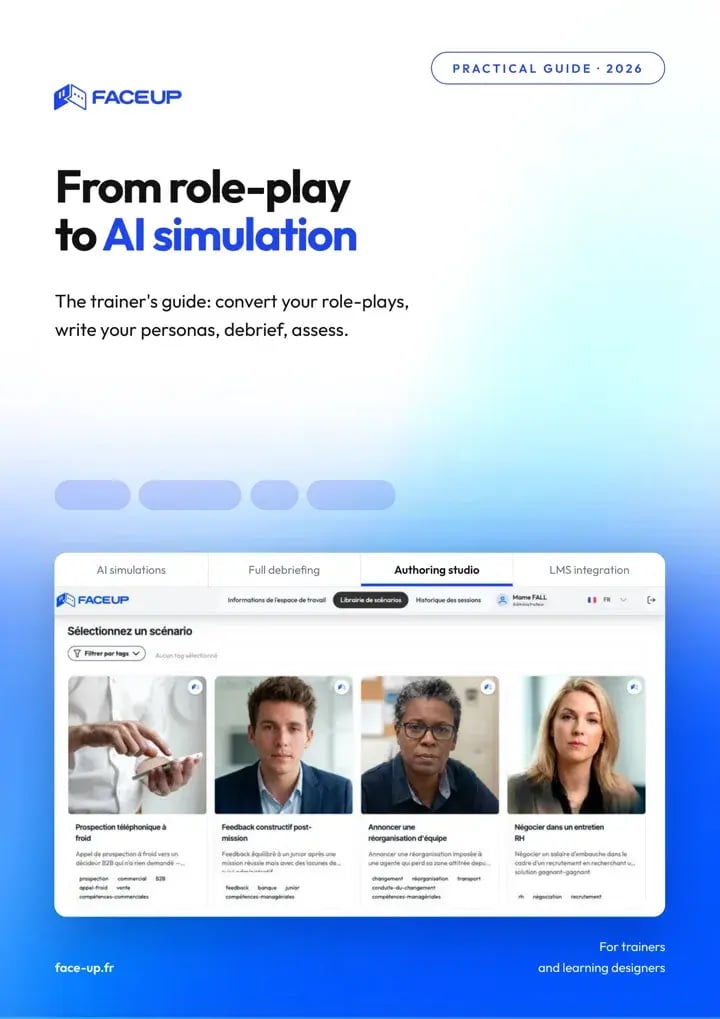
22 pages. For trainers and instructional designers who already run role-plays.
Do the maths
Typical calculation for a one-day session with twelve participants, detailed in the guide.
Inside
And what it cannot do: the constraint is logistical, not educational.
What stays in the classroom, what moves to self-paced practice, what disappears.
Turning an existing role-play around, column by column, with a worked example.
The four layers, the template to fill in, the DISC profile, and the mechanism that makes it real training.
What goes wrong in a first scenario, and what you write, or never write, in a debrief.
A grid per job, Qualiopi, GDPR and the AI Act, then a thirty-day checklist.
Excerpt · The conversion grid
The context of the situation.
The brief handed to the peer playing the role.
The history of the relationship.
Your observation grid.
The character explains everything in the first thirty seconds. The learner succeeds without learning anything, and gets bored.
Nothing opens up whatever you do. The learner concludes that "the AI does not understand", and is right to think so.
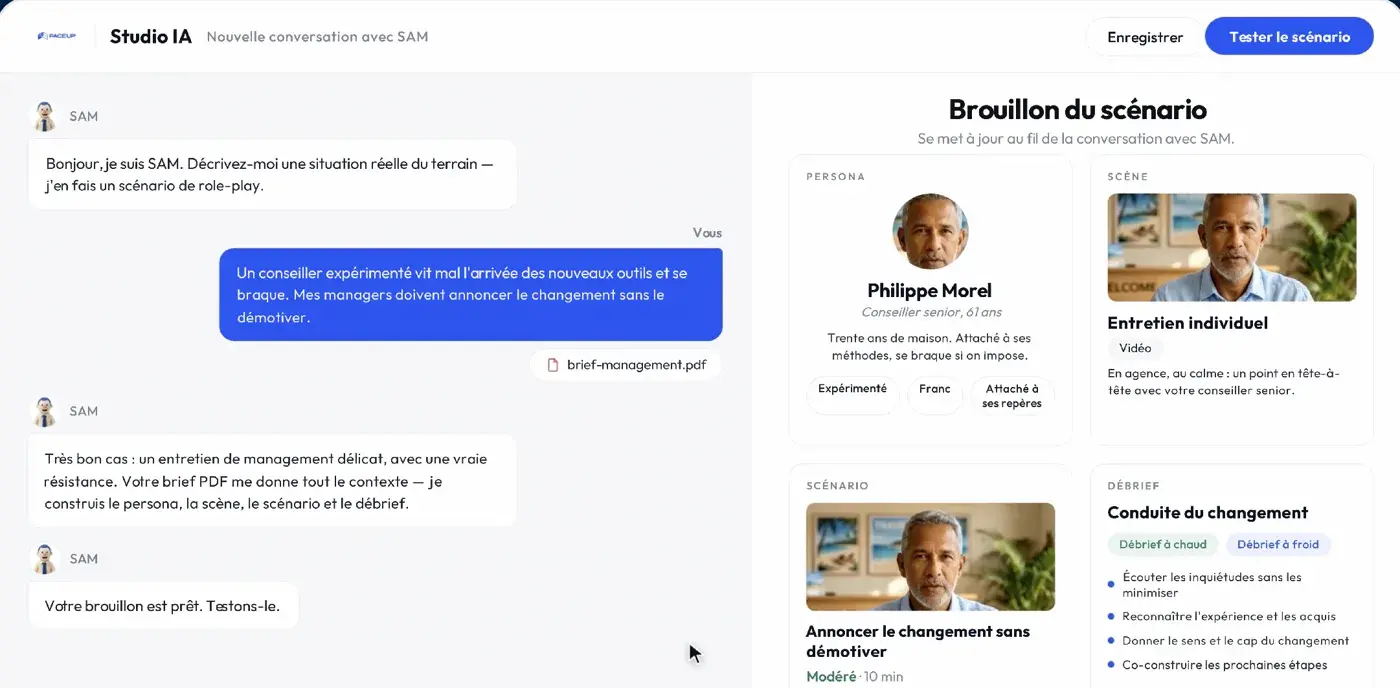
The AI Studio
“AI role-plays and the quality of the feedback save training centres an enormous amount of time.”Thierry Bonetto, former HR Director for Training, Danone
“AI simulations let learners practise far more, without adding to the trainers' workload.”Pierre Bacrot, training centre director
The guide gives you the method, column by column.